More Pictures Today


dsc03599.jpg

The last 500-meter uphill part of the course!

dsc03601.jpg

The finish line…

My Pictures Today (08 Nov ’07)


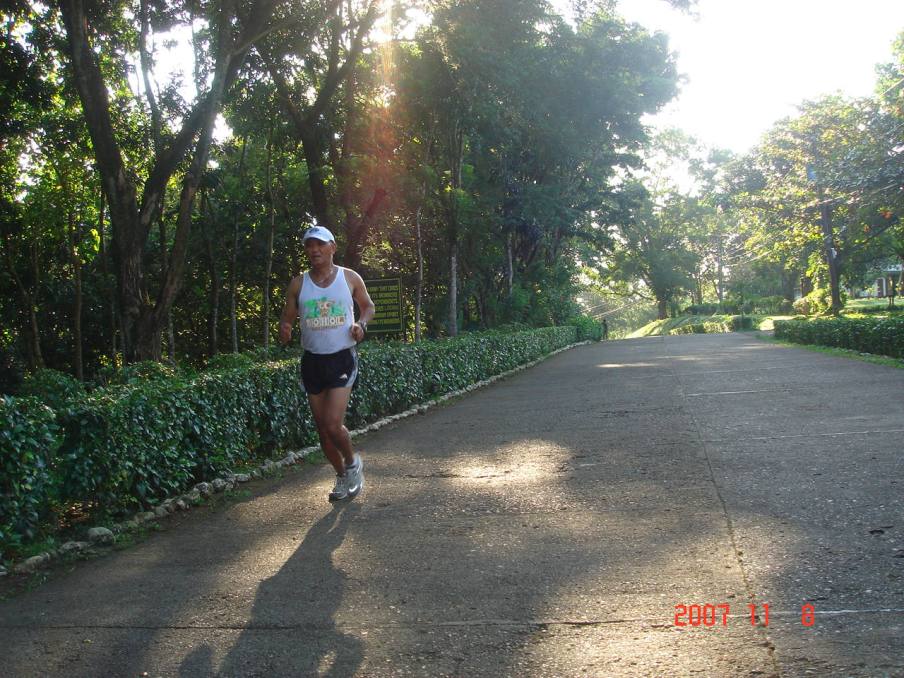
dsc03597.jpg

I started my running at 5:30 AM from my quarters, going outside the camp towards the Poblacion of Jamindan, Capiz. This picture was taken inside the camp on my way back to my quarters. The distance from my quarters to the Brgy Aranda Crossing is 7 1/2 kilometers and I ran it in 40:30 mins. I was running at a pace of 5:24 minutes per kilometer.

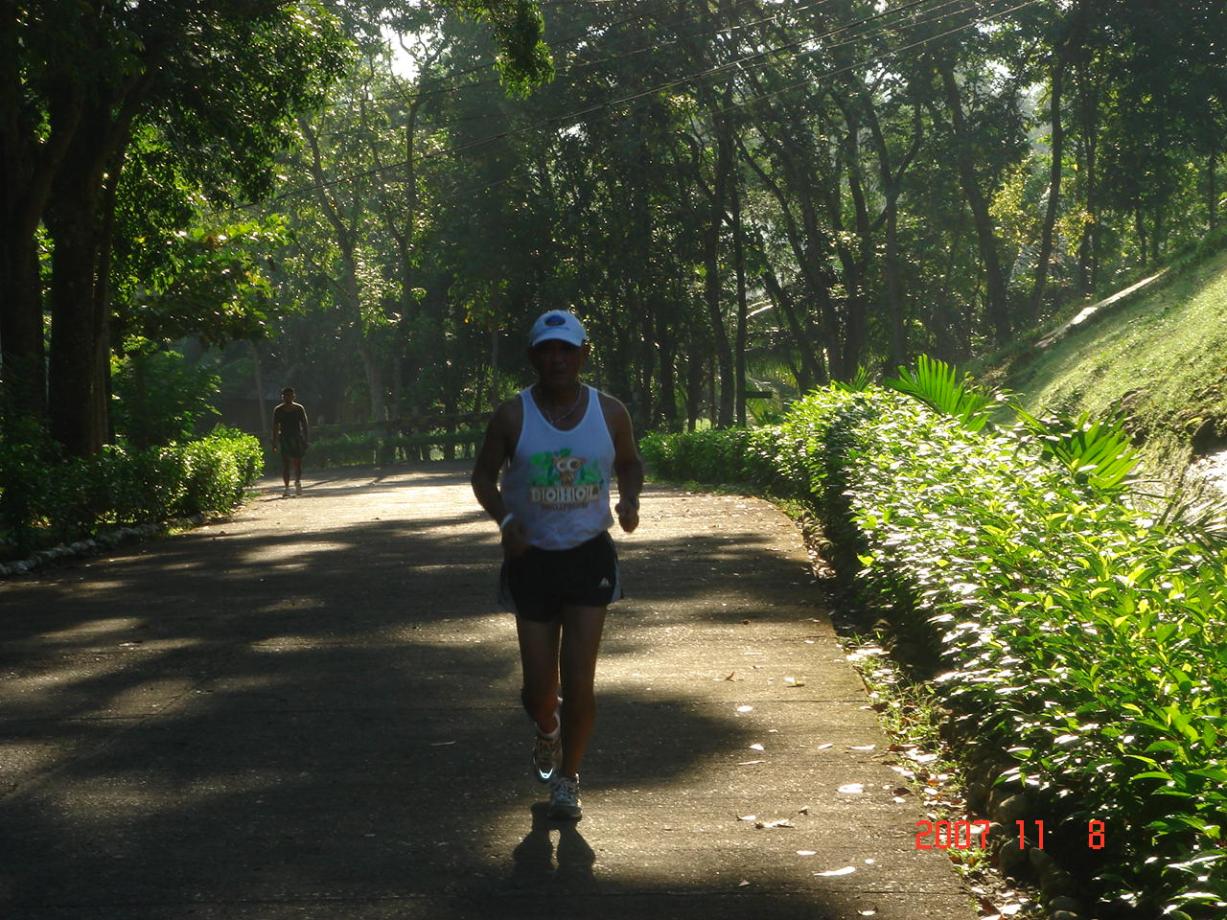
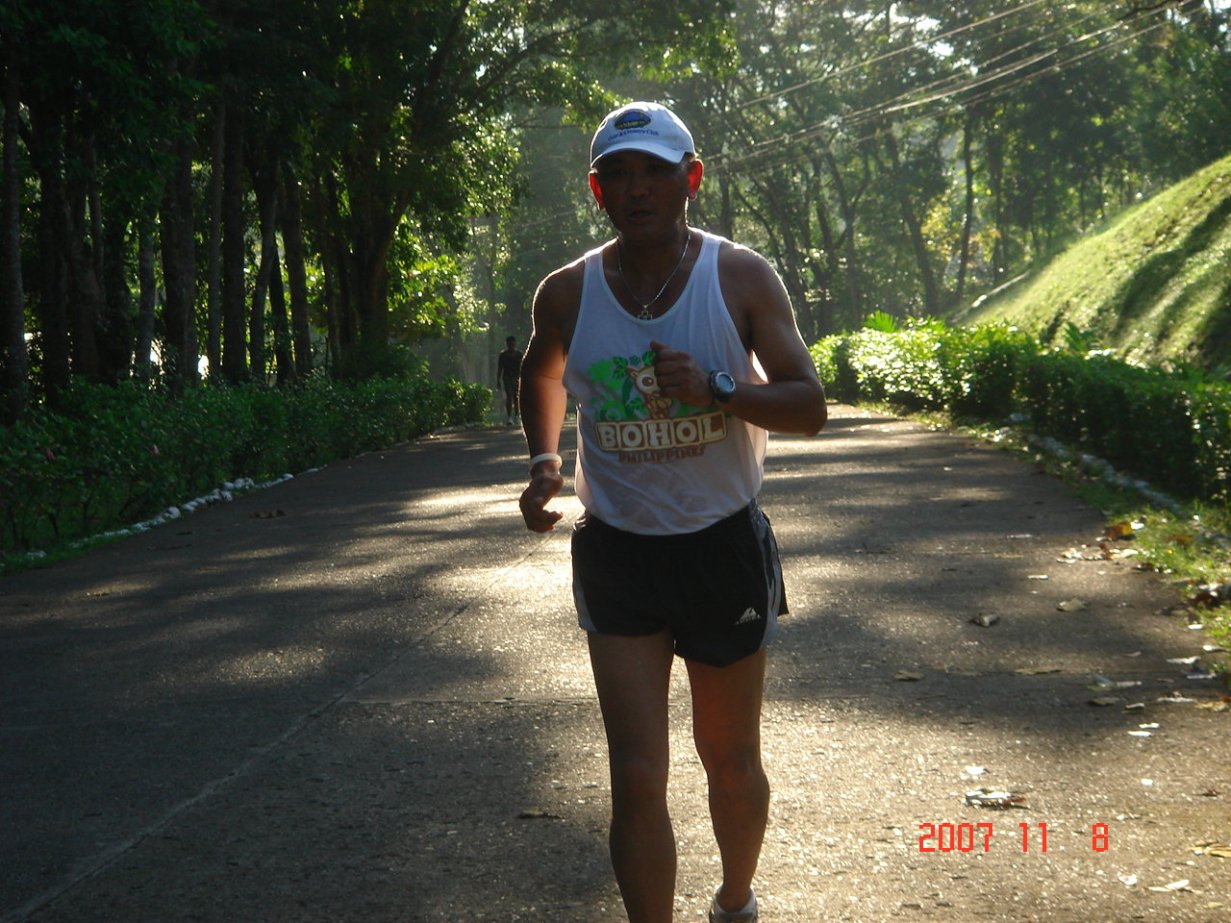
dsc03598.jpg

I am using my brand new Accel Running Shorts, new cotton singlet/sando from Islands Souvenir which I bought at their store in Bohol Chocolate Hills, my reliable Casio “Sea Pathfinder” Titanium Watch, M716 New Balance Running Shoes, “ONE” Wristband, and my old Fort Ilocandia Golf Club Cap. The Accel Shorts costs me P 350+ and my sando costs me P 250+, cheaper and more comfortable than the Nike Running Apparels.

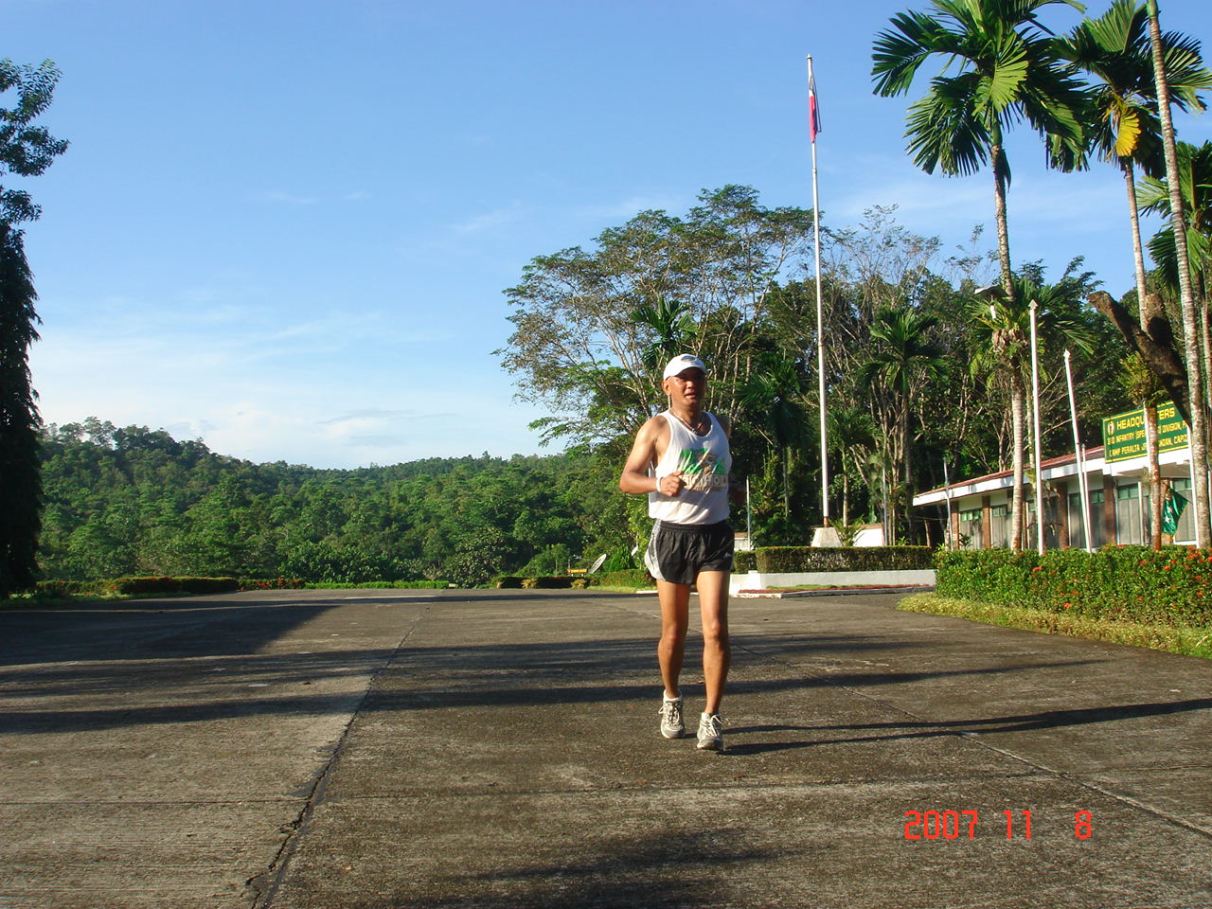
dsc03601.jpg

I finished my morning run infront of my office/Headquarters. From the turnaround point at Brgy Aranda Crossing to this place, I finished in 41:20 mins. The last 1/2 kilometer was a killer due to the steep grade going up the camp. Overall, I ran a total of 15 kilometers for a time of 1:21:50. My average pace was 5:27.3 per kilometer. I did not stop or walk along the way but I had to drink some bottled water while running–when I reached the turnaround point at Brgy Aranda Crossing and at the 2-km marker before reaching the camp.

2006 Pasig River Heritage Marathon: Results


Source: Association of International Marathons and Road Races (AIMS): RESULTS

26 FEBRUARY 2006: PHILIPPINE MARATHON FOR THE PASIG RIVER

Gripping drama characterized this second marathon edition in Metro Manila. In the midst of the country’s political turmoil, the marathon nevertheless started and ended without a hitch.

The top two men are in-house athletes of the Philippine Army, who, at that time, were under red alert following a Presidential Proclamation placing the entire country under a “State of National Emergency.”

On the women’s side, youth triumphed over experience when Jhoan Banayag, of the University of the East Athletics Team, won over a veteran field which included last year’s winner Maria Estela Mamac-Diaz.

This was the first time, including the first four years when the road race was known as the Pasig River Heritage Marathon, that an international-calibre runner was among the 903 starters. Robert Njoroge Wambugu flew in barely four hours before the gun with little more than a pair of training shoes. Fellow competitor Cesar Bollecer of Direct Link Running Club, showing the visitor the unique Filipino brand of hospitality, exchanged running shoes with him on the start line, but the drama did not end there.

Njoroge, benefitting from his extensive international exposure, immediately took the lead. But after two of the course’s nine bridges, jet lag, lack of sleep and the warm weather began to tell on his legs, allowing the locals to catch up and pull away. Dropping to a 10th-place finish, Wambugu vowed to be back to redeem himself in next year’s edition.

The marathon is an advocacy project of the Clean & Green Foundation Incorporated on behalf of the Philippine Government’s Pasig River Rehabilitation Commission. It seeks to harness the people’s participation in the long-running Pasig River rehabilitation program.

The Pasig River is the Philippines’ most historical and important inland waterway, which runs from east to west dividing Metropolitical Manila into north and south areas. The country’s history in the last 400 years is closely intertwined with the river, spanning Spanish, British, American and Japanese colonial occupations, revolutions, world wars, and local uprisings. Located along its banks are the Filipino’s most historical districts, buildings and sites.

MEN:
1  Cresciano SABAL             PHI  2:26:13
2  Bernardo DESAMITO           PHI  2:30:29
3  Memerto CORPUZ              PHI  2:32:24
4  Regelio de Leon SARMIENTO   PHI  2:35:28
5  Rodolfo TACADINO            PHI  2:36:02
6  Allan BALLESTER             PHI  2:37:00
7  Jujet DE ASIS               PHI  2:37:24
8  Michael CANILLO             PHI  2:38:11
9  Wilson MANINGKIL            PHI  2:39:26
10 Robert WAMBUGU              KEN  2:40:00
 
WOMEN:
1  Jhoan BANAYANG              PHI  3:02:37
2  Flordeliza CARREON-CACHERO  PHI  3:09:13
3  Ailene TOLENTINO            PHI  3:09:28
4  Ma. Estela MAMAC DIAZ       PHI  3:09:42
5  Liza DELFIN                 PHI  3:24:22
6  Merlita ARIAS               PHI  3:34:17
7  Mila PAJE                   PHI  3:37:04
8  Marychiel MINAS             PHI  3:41:18
9  Joanne MANANGAT             PHI  3:43:58
10 Genevieve DELA PENA         PHI  3:44:39

2005 Pasig River Heritage Marathon: An Experience


Prior to this marathon event, the last marathon race that I finished was the 1997 PAL Manila International Marathon. But in-between these races, I have been joining 10 to 20 K Road Races in Metro Manila.

A collegue of mine who is also a passionate runner and two years older than me, invited and urged me to join the 2005 Pasig River Heritage Marathon seven months before the D-Day (27 February 2005). Because we had been together joining marathons in previous years, I accepted the invitation even if I had a very delicate and sensitive job with hectic schedules to follow. I have to squeeze in at least one hour every day for my running practices in Metro Manila.

My practice runs and schedules were not consistent and I was not making a log/journal of my daily runs. My weekend long runs were limited up to a maximum of 25 kilometers. Basically, I did not follow strictly my past training strategy of building-up strength and resistance by running more distances and logging more miles. I did not had any speed plays/runs. I did not had the chance to run for higher altitude training in Baguio City as my practice runs were limited in Fort Bonifacio, The Fort/Global City area, Camp Aguinaldo and the Libingan ng mga Bayani Grounds.

I had to strengthen my legs and upper body muscles through daily weight training at the Gym by using free weights, Nautilus/Life Fitness Machines, and Yoga sessions. Although I did not had any Personal Trainer, I concentrated my workouts to my buttocks, legs, arms and stomach muscles. I did not use heavy weights as I did not want bulky muscles but I needed my muscles to be toned and stronger. I used lighter weights but with more sets and repetitions. Yoga sessions made me more relaxed and my muscles stretched every after gym workouts.

I know in my mind that I was not after a PR best time for a marathon at this time when I am already old and reaching the age of 53 years old, and after a long lull and absence of serious training and marathon race for the past eight years. I know then that I was courting disaster or encouraging self-inflicted pains to my body after running this marathon. Well, I just simply put in my mind that my goal to run this marathon event is to be able to finish in less than five hours and be able to recover fast without any injuries or encounter any “bad signs/problems” to my body. I just wanted to survive finishing the race with no injuries.

The following are the insights, observations, comments, experiences and recommendations during the said marathon event:

1) The registration fee was P 500.00 and it covered a “carbo-loading” event a day before the race, a Finisher’s T-shirt, and a Certificate of Finishing the Marathon. The “carbo-loading” was done at “The Tent” at The Fort which was scheduled at 5 PM the day before the race day. The “carbo-loading” was not organized and the food was so bad and disgusting that each registered runner was given a small amount of spaghetti in small styrofoam packs. The pasta/spaghetti was not well-cooked. I ended not eating the food as this was my first frustration in the said event. Instead, I went to the nearby Jollibee and ate two (2) orders of Spaghetti w/ Yum Burger Meal.

2) Before the start of the race, a prayer for the runners was led by an “activist-running priest” who was very popular in criticizing the programs and policies/pronouncements of the government and the present administration. I could not see any reason why the organizers would invite this priest to an event which is being fully endorsed and supported by the government through a Presidential Proclamation which was duly signed by the President of the country.

3) The start of the race was delayed by almost 15 minutes. It was scheduled to start at 5:00 AM.

4) The streets/route on the first three kilometers were very dark and could hardly see where your feet were landing on the ground. Some of the street portions near Intramuros were wet and the smell of the surroundings was so bad. I had to run slowly while passing through these places to avoid the slippery ground.

5) Our group and some runners ran an extra two kilometers as we were going to the wrong direction towards the Manila Hotel because we got lost along the way. This was due to the late arrival of road marshalls and no directional signs were seen within the first five kilometers of the course. This really made me angry along the way and it took so much spent energy from me, psychologically and physically. I was cursing the organizers while I was running.

6) Water stations were lacking along the route. I anticipated this problem by bringing some of my staffs to provide me with a handy water jug/s. These jugs are like the ones used by cyclists. They “leap-frogged” from one place to another along the route. There was also this runner who was asking some water from my personal water jug every kilometer that we ran. It really annoyed me while I was at the Makati area.

7) I have observed that most of the “first time” marathoners/runners were wearing belts with small pockets holding small plastic cannisters. Well, I assumed that they were carrying water or energy drinks on their waists. Later, I found out in a Nike Store that this belt is called “Hydration Belt”. I was smiling and wondering why these runners are carrying extra weight on their bodies while most of the experienced runners are trying to be light as possible by buying the lightest running shoes and the lightest running apparel/shorts & singlets..and running socks! These “hydration belts & camelbaks” are highly recommended for long distance practice runs. The weight of the water strengthens the leg muscles and provides immediate replenishment of water loss from the body during practice.

8) I started to have “muscle cramps” on my calves on both legs when I reached the 25 Km marker. I had to walk and jog, alternately from the Guadalupe Bridge going up to EDSA up to Crossing Shaw Boulevard. I reached my “wall” at the 30 Km marker and it was a fight between finishing the race against DNF which I could not accept. From the Bridge along C5 (at the intersection of Shaw & C5) up to the Finish Line at The Fort was the “longest” five kilometers of my life. It took me more than one hour to walk & jog & stretch my leg muscles to finish the last five kilometers of the course. The C5 stretch was the hardest as the heat of the sun was so hot to the skin and body and it was 9:00 AM already. I was glad that I had some members of my staff who provided me with the much needed water to drink and cold shower for my body along this last few kilometers of the course. My dark skin was burned because of the heat of the sun. I should had used and applied a Sun Block before the race.

9) I had to pray, chant, maintain my breathing rythym, think positively that I could finish the marathon, curse the organizers, curse myself for not training so hard and prepared properly as I had done when I was younger, I remember missing my altitude training in Baguio City, thinking of trying to pick up some runners ahead of me whom I could plan as targets to overtake, sometimes think why am I running the marathon…what’s the point?, why am I punishing myself.

10)  I could not remember if I was given a Finisher’s Medal after crossing the finish line. I finished and survived the race in 5 hours & 10 mins +. I was short of getting my goal of running the event in less than five hours but I was able to finish the race and to recover so fast that I could have my practice runs again after two days of rest. I had no injuries and body pains after the race. My collegue finished the race thirty minutes ahead of me.

11) This was my first experience to run and finish the Pasig River Heritage Marathon and because of the bad experiences and observations, I promised myself not to run the next edition of the race. So, for the 2007 Edition, instead of running the marathon, I ran the 10K race just to observe and see the top finishers of the Marathon.

12) I recommend that a professional and prestigious race event organizer should manage and administer the Marathon.

I just hope that for next year’s edition of the Pasig River Heritage Marathon, the overall conduct of the race will improve for the best.
Pasig River Heritage Marathon


Hereunder is  a Presidential Proclamation which in itself is a directive and authority for the conduct of the yearly Pasig River Heritage Marathon in Metro Manila (Philippines) which is usually held on the last Sunday of February.


It appears that the Clean and Green Foundation, Inc. and the Pasig River Rehabilitation Commission are the main  offices/entities vested to manage and administer the conduct of the Pasig River Heritage Marathon in collaboration and support from the different Presidential Cabinet Offices.


I really do not know the persons and personalities running these “main offices/institutions” in the conduct of the said marathon but I will make a separate postings on my observations when I joined the 2005 Pasig River Heritage Marathon Race on 27 February 2005.


Later, the name “Philippine Marathon For The Pasig River Day” was changed to its present name as “Pasig River Heritage Marathon”.


MALACAÑANG

Manila

BY THE PRESIDENT OF THE PHILIPPINES

PROCLAMATION NO. 780

DECLARING FEBRUARY 27, 2005 AS “PHILIPPINE MARATHON FOR THE PASIG RIVER DAY” AND THE MONTH OF FEBRUARY 2005 AND EVERY YEAR THEREAFTER AS “PHILIPPINE MARATHON FOR THE PASIG RIVER MONTH

WHEREAS, the Philippines, being a signatory to several international conventions on the environment, manifests a strong adherence and commitment to international environmental laws;

WHEREAS, the Department of Tourism is mandated to develop sustainable tourism and ensure the sustainable use, develop and management of the country’s environment, natural resources and cultural heritage;

WHEREAS, the Pasig River Rehabilitation Commission is mandated to undertake the rehabilitation of the Pasig River and ensure its ecological well-being;

WHEREAS, the annual Pasig River Heritage Marathon is one of the biggest events in local sports and environmental advocacy and has been accredited by the International Association of Athletic Federations and the Association of International Marathons and Road Races, thereby making it an official international marathon event.

NOW, THEREFORE, I, GLORIA MACAPAGAL-ARROYO, President of the Republic of the Philippines, by virtue of the powers vested in me by law, do hereby declare February 27, 2005 as “Philippine Marathon for the Pasig River Day” and the month of February 2005 and every year thereafter as “Philippine Marathon for the Pasig River Month”. All concerned departments and agencies of the government are enjoined to participate in the celebration by properly observing the event and actively supporting the programs and activities related to this occasion.

The Department of Interior and Local Government, Department of Environment and Natural Resources, Department of Tourism, Department of Transportation and Communication, Metro Manila Development Authority, Philippines Sports Commission and all local government units in the National Capital Region are hereby directed to fully collaborate with the Clean and Green Foundation, Inc. and the Pasig River Rehabilitation Commission to ensure the success of the programs and activities related to this event.

DONE in the City of Manila, this 7th day February, in the year of Our Lord, Two Thousand and Five.

(Sgd.) GLORIA MACAPAGAL-ARROYO

By the President:

(Sgd.) EDUARDO R. ERMITA
Executive Secretary


Where Are Those Running Shorts?


Four years ago, I was able to buy two (2) sets of running attire (singlet & shorts) from the Nike Store, colored yellow and black. For some time, I haven’t used these attire but when I showed them to my son, I felt that he liked them, So, I gave them without any hesitation with the thought that I could buy another set of these running attires. But to my frustration, I haven’t been able to locate and buy those running attire from the Nike Store up to this time.

During the ’80s, I’ve been using those Adidas running shorts and “copycats” from Botak Running attire. In the late ’90s, Speedo came up with running shorts with curved edges on its side which was made of water-proof clothing material. The Speedo shorts are light and comfortable. I got two of these and I am still using them in my practice runs. Later, Speedo came up with shorts which could be used for swimming and running and that’s the one I am using in my competetive runs.

I also have those stretchable cycling shorts made for running (without pads) which are being used by elite runners but I guess, the Filipino runners are not yet adapted and used to this kind of running attire. During my races in the US in the mid-’80s, I’ve been using these cycling shorts and sometimes tight & stretchable jogging pants during cooler months. Also in the US, I was able to wear those “mid-rib” shirts during summer months. Today, wearing a tight & stretchable “mid-rib” shirt and  a tight “cycling shorts” in competetive races in this country is a fashion statement!

Two months ago, after going through all the Nike Stores in Manila, Cebu and Iloilo, I accidentally browsed around inside the SM City in Iloilo and found a nice running shorts from Accel and it was cheap. The length is too short which resembles to the “old running shorts” in the ’80s. Although I have used it once in my speed play workouts, I found the shorts very comfortable and found myself to be back in the ’80s again.

“Shuffle, Don’t Bounce”


When I joined the 1st City of Angels Half-Marathon Race in Los Angeles last December 4, 2006 with my daughter, I observed that she was “bouncing” during the run. “Bouncing” means that you are pushing much of your legs after your foot hits the ground. In effect, the whole body is bouncing as you run, creating extra effort to your legs, knees and body. Sometimes, bouncing creates a semblance of being suspended on the air for a half of a second before your leading foot strikes the ground. Well, I didn’t mind her style of running while we were on the race but I encouraged her to increase her speed and maintain her cadence and breathing rythym on the last 3-4 miles before the finish line.

Immediately after the race, she was happy that she was able to improve her PR best time for the distance by 12 minutes. I congratulated her for the determination she had shown despite for the reason that she just had her “monthly visitor” (which she told me only after the race!). Anyway, while we were walking back to home (our house is 2-3 miles away from LA City Hall), I told her about her tendency to “bounce” during running.

Of course, she told me that she is not “bouncing” when she runs. I described and demonstrated how she was “bouncing” while running. I also demonstrated to her how to “shuffle” while running. I suggested and recommended to her to adopt the “shuffle” style of running.

Basically, I am a “shuffler”. Shuffling means that a runner does not need to raise his/her knees too much in the air and the foot should not be ahead of the knees while running. It is an exaggerated trotting of the feet with the ball of the feet or heel hitting much of the ground. This is the most relaxing way to run with the knees not being forced to exert extra effort. It takes time to practice and adopt this kind of running. But for me, this is the best running style I recommend for runners training for their first marathon.

My running models in marathon in the ’80s; Bill Rodgers, Alberto Salazar, Robert de Castella, Toshihiko Seko,  Steve Jones, and Waldemar Cierpinski; were all “shufflers”.

My God, I am really that old and bald if you don’t know these famous marathoners in the past!!!

High Altitude Training


I accidentally deleted my previous posting on this topic. I posted this topic while I was in Boracay Island for two days.

Altitude Training or High Altitude Training dates back after the Mexico Olympic Games in 1968 where the city is located 2, 240 meters above sea level. It was at this time when world records on sprints and endurance sports were broken and some of the time records then were not yet surpassed up to this time. Most of the athletes from the high altitude places of Africa, Finland, and New Zealand had excelled in endurance sports events.

Scientific studies showed that when the body is exposed to altitude training, there is less oxygen in the air and due to less oxygen intake, the body tends to develop new red blood cells. New red blood cells means more oxygen in the blood which is translated to more speed, power and endurance.

This is the very reason why it was a part of my planning, practice and strategy to have my practice runs in Baguio City for a minimum of one month up to a maximum of two months. Although Baguio City (1, 530 meters above sea level) is not as high as Mexico City, it was the most accessible place where I can have my altitude training.

I may not be as competetive as the national athletes at that time who were training in Baguio City, but I knew that altitude training gave me more endurance to finish the marathon race without any pains and had faster post recovery than the other runners. In all my marathon practices, I saw to it that Baguio practice runs were part of my training/s.

Simulated altitude training gadgets are already available in the market by elite athletes in other more developed countries but they are expensive. However, I don’t recommend such gadgets/tents to average runners. Actual practice runs in higher elevated places is highly recommended as it is more affordable and economical.

Baguio City is still my best bet to practice altitude running/training. The route from Silang, Cavite to Tagaytay and running within Tagaytay area is also an option. Another option which I tried before is the route from the UP Los Banos Grounds to Mt Makiling peak.

Running in Boracay


dsc03339.jpg

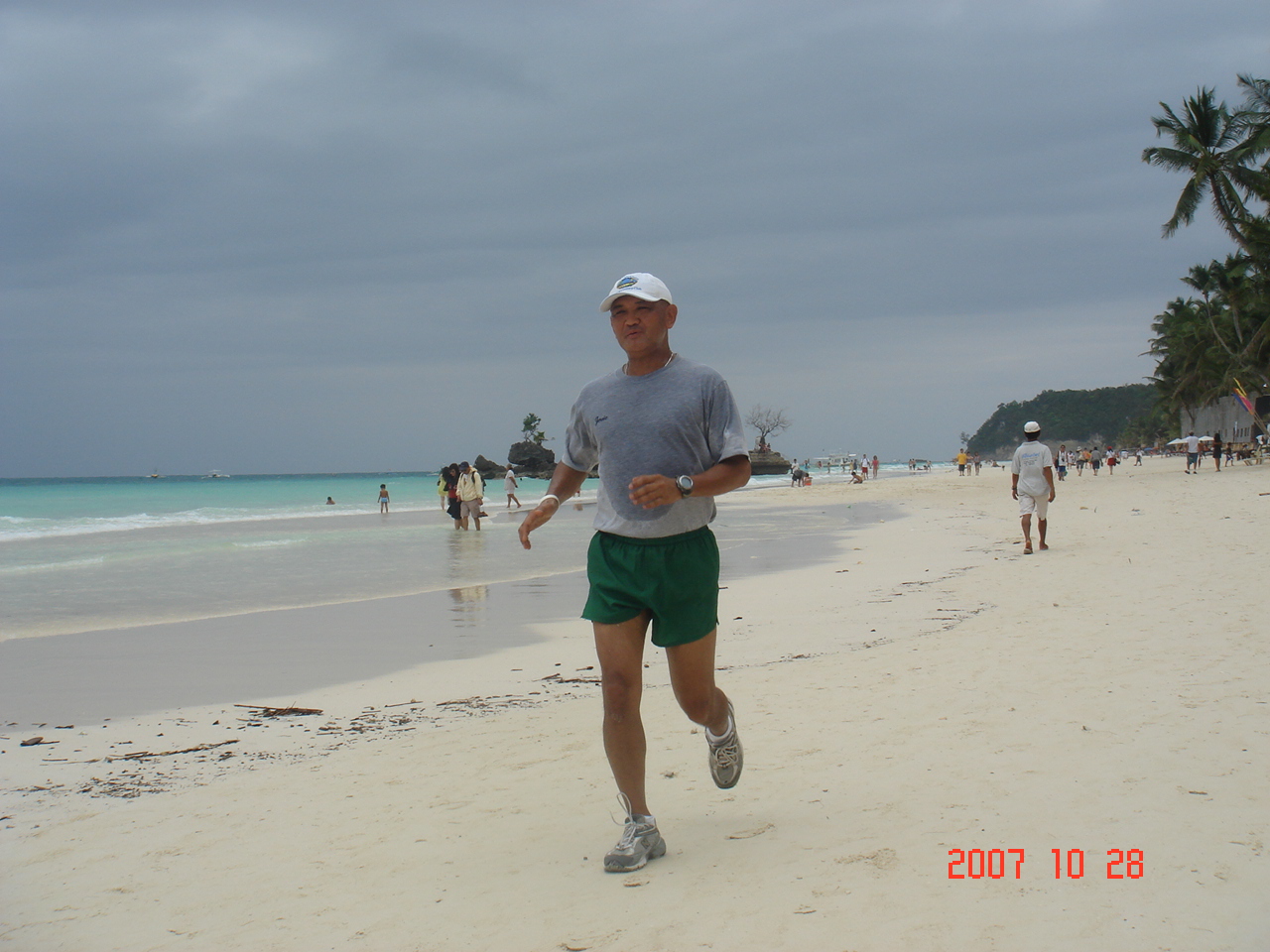
I had 40 minutes speed play along the beach of Boracay on 28 October 2007. It was a nice workout with winds coming from the North.

My First Marathon Race


If my recollection serves me right, I had my first marathon in 1981 after I successfully proven to myself that I could be a better competetive runner. The PMA Alumni Race where I won number 2 inspired me to plan and run for the Marathon Race.

At that time, I was assigned in Region 1 (Northern Luzon) and my work included going to all the provinces of Ilocos Norte, Ilocos Sur, La Union, Pangasinan, Abra, Mt Province, and Benguet conducting seminars, lectures and meeting local government officials. However, most of the time, I stay in Laoag City because my office and staff were located thereat.

I am a product of the “Old School of Running”—build-up enormous mileages for 3-4 months and slowly build-up and combine speed workouts for 2 months and “simulate” running the marathon distance for the last one month before the marathon race.

In order to build mileage for the week, I have to run early in the morning for 10 kilometers and another 10 kilometers in the afternoon/early evening. And I did this from Monday to Friday. I usually run from our office in Laoag City to the Ft Ilocandia Golf Course and sometimes from Laoag City Poblacion to the Ft Ilocandia Hotel. The road/course is nice. And at that time, there were less traffic and vehicles plying those routes. On Saturdays, I do my long slow runs reaching up 20 to a maximum of 25 kilometers. Sunday was my rest day. Sometimes, I do my long runs on Sundays and make Monday as my rest day, and start my weekly runs on Tuesdays. Progressively, I increased my daily runs up to 15 kilometers per session and increase my weekend long runs up to 30 kilometers.

My speed workouts were done in the athletic oval of Laoag and sometimes in the athletic oval of Teachers Camp in Baguio City (the one that was used by the Gintong Alay athletes of Michael Keon). My speed plays vary when I am in the oval but most of the time they consisted of 400-meter fast and 400-meter recovery runs by jogging slowly. I usually do 10 to 15 repeats of the speed runs. However, I became creative with my speed plays. I did my speed runs on my road runs by using the kilometer markers as my reference points (alternately, running faster in-between two kilometer markers and then doing my recovery/slow jog up to the next kilometer post). Sometimes, I use the electric posts along the road/streets as my reference points for shorter speed plays. But what made me more creative was when I discovered the “color-coded” foot trails around the perimeter-slopes of Camp John Hay Base in Baguio City (when the Americans were still running/managing that camp). In every sector of the perimeter of the camp, the trunks of the pine trees along the trails were painted with spots of dark red, green, blue, orange, and white paints. So, I alternately did my speed plays every other colored trail while running. I really don’t know if these “color-coded” trails are still there.

To “simulate” or practice the marathon one month before the race, I should be able to run at least 35 kilometers during my weekend long slow distance workout with minimum effort. I have one of my men “leapfrog” every 3-4 kilometers for my regular water intake/supply. I start my run at the same time with that of the race starting time.

I did my practice runs alone on the road, ovals, and trails.

I finished my first Marathon race, the Manila International Marathon, in 3 hours; 24 minutes; 46 seconds.

Finishing my first marathon race entails planning, hardwork, persistence, patience, discipline and commitment to finish the race. Such values and attitude I need to pursue my life and carreer in this ever challenging and unpredictable world.

Marathon race is life in itself.